Titanium valves
Why titanium?
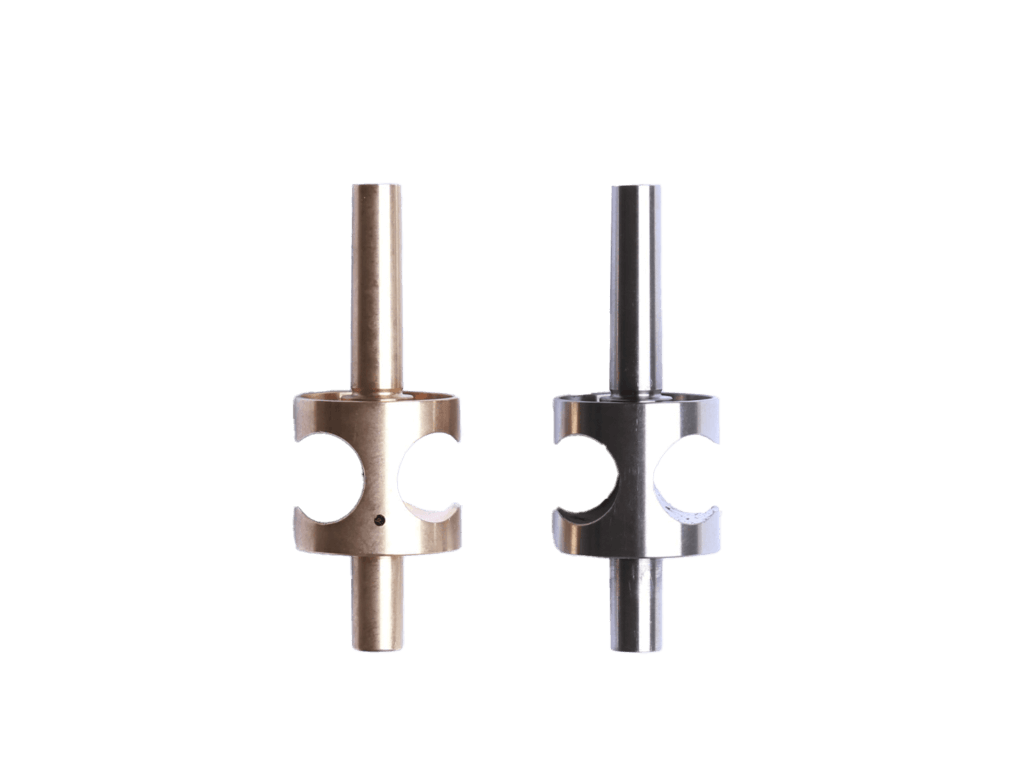
Because of its low density, high strength, and excellent corrosion resistance, we use titanium for our rotary valves.
With a density of just 4.43 g/cm³, titanium weighs about half as much as the traditionally used materials brass (8.5 g/cm³) or bronze (8.7 g/cm³). This significantly reduces the moving mass of the valve.
The reduced moving mass ensures smooth operation and allows for precise adjustment of the spring pressure. This advantage is particularly noticeable with larger instruments.
For example, a titanium baritone rotary valve weighs about as much as a brass trumpet rotary valve.
For our valves, we use Grade 5 titanium (Ti6Al4V), a material that is also used in the medical and aerospace industries due to its properties.
Hygiene
The interior of an instrument usually remains hidden. However, when we overhaul our instruments, we regularly gain insight into their condition after many years of use.
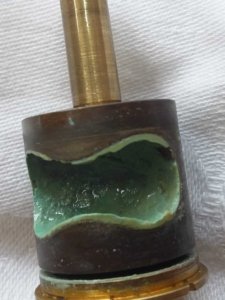
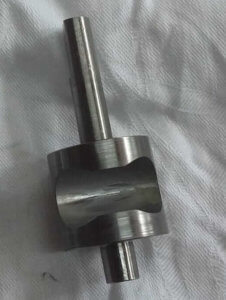
The pictures show a brass valve on the left after two years of use and a titanium valve on the right after five years of use.
It is clearly evident that, due to titanium’s high corrosion resistance, significantly fewer deposits form on its surface. This helps ensure that the valve’s surface remains clean over time and that its properties remain consistent.
It is not without reason that titanium is also used in medical technology—for example, in artificial joints—due to its excellent biocompatibility and corrosion resistance.